
CBA and Professional Training takes center stage
Pedagogic seminar
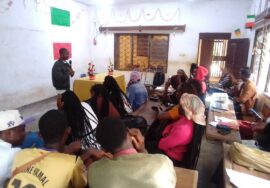
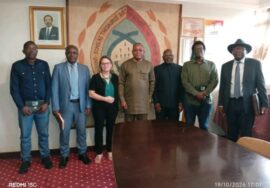
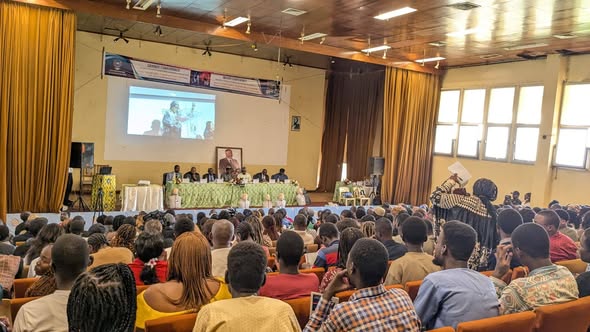
The University of Dschang hosted a seminar on university pedagogy, the Competency-Based Approach (CBA), and the professionalization of training, in an event that reflected both institutional vision and academic commitment to educational transformation. The seminar, held on Friday, 22nd may brought together over 200 participants and a host of panellists to reflect on the future of teaching and learning in higher education. Coordinated by the Secretary General, Prof MOUOU Moise under the auspices of the Rector of the University, Prof Roger Tsafack Nanfosso.
This pedagogical forum focused on how universities can train graduates who are not only knowledgeable, but also competent, adaptable, and ready for professional life. In a context where higher education is increasingly expected to respond to labour market demands, innovation, and social development, the seminar addressed a central question: how should university training evolve to remain relevant?
The first sub theme focused on “The Competency-Based Approach in higher education, pedagogical tools, and the posture of the teacher, the learner, and the institution.” The theme highlighted the fact that competence-based education is not limited to curriculum reform. It also requires a new pedagogical culture, a stronger relationship between teacher and learner, and closer alignment between academic content and practical application.
Among the presentations delivered during the session, the intervention of Professor SHUAIBU HADJI of the Faculty of Education, University of Yaoundé I, was particularly notable. His presentation on Artificial Intelligence as a support tool for competence-based teaching brought a contemporary dimension to the seminar and opened a meaningful discussion on the place of technology in modern pedagogy.
Professor Shuaibu Hadji emphasized that artificial intelligence should not be seen as a replacement for the teacher, but rather as a support tool that can strengthen teaching effectiveness, improve learner engagement, and facilitate competence acquisition. His intervention underscored the idea that the university teacher remains central to the learning process, but must now also know how to use digital tools that can enrich and personalize learning.
The strength of his presentation lay in its practical orientation. He showed that competence-based teaching requires more than the simple transmission of information. It requires methods and tools that enable students to learn actively, interact meaningfully with knowledge, and demonstrate what they are able to do with what they have learned. In this perspective, artificial intelligence can support personalization, feedback, assessment, and academic guidance. At the same time, its use must remain ethical, careful, and pedagogically grounded.
Other presentations in the session reinforced the same direction. Discussions on the affective relationship between learner and teacher in the CBA, the construction of a competency framework in line with the BMD system, the integration of the CBA into university pedagogy, the role of explicit teaching as a didactic lever, the contribution of the CBA to territorial entrepreneurship, and the question of whether the CBA represents a rupture or continuity in the philosophy of education all pointed toward one conclusion: the transformation of higher education requires more than technical reform. It requires a deeper change in pedagogical posture, institutional priorities, and educational philosophy.
The seminar also created a valuable platform for exchange among universities. By bringing together panelists from different academic institutions, it encouraged dialogue across disciplines and highlighted the shared responsibility of universities in shaping the future of higher education in Cameroon. Certificates of attendance were awarded at the end of the first and second sessions.
At the end, the first session of this seminar succeeded in setting the tone for a broader conversation on the future of university training. With strong institutional backing, diverse scholarly contributions, and a particularly relevant intervention from Professor Shuaibu Hadji, the seminar demonstrated that the future of higher education lies in the careful balance.